What Is Thermal Imaging?
Every surface gives off infrared radiation, and the amount varies with its temperature. An infrared camera measures that radiation and turns it into an image, a thermal image, where warmer and cooler areas show as different colors. This is called infrared thermography, and its subject is always the same: surface temperature.
That distinction matters. A thermal image is not a photograph of water inside a wall, and the camera does not see through walls or show water flowing inside a pipe. What it shows is temperature variation across the surface, and because damp material often sits at a different temperature from dry material around it (evaporation cools it, or a warm water line heats it), moisture problems frequently leave a readable pattern. The pattern is a clue that directs the next step of the investigation; it is never, on its own, the conclusion. For the wider picture, see the DeSoto leak detection overview.
The limit is central to this service: a thermal pattern is a reason to measure and investigate further, not proof of a leak by itself. The educational guide explains what thermal imaging can and cannot show in more detail.
How Thermal Imaging Can Support a Leak Investigation
Used properly, a thermal camera earns its place in four ways:
- Mapping unexplained moisture patterns. A cool patch spreading across a ceiling or down a wall, in the shape moisture would take, helps define the affected area far better than the visible stain alone.
- Comparing temperatures around a suspected concealed leak. Scanning around pipe runs, fixtures and penetrations can reveal anomalies worth checking with other instruments.
- Identifying areas that warrant further assessment. The camera's real output is a shortlist: these spots justify a moisture-meter reading, a pressure test, or a closer look, and the rest of the wall does not.
- Directing other investigative steps efficiently. Instead of testing everywhere, follow-up methods go where the thermal evidence points, which keeps the investigation focused and less disruptive.
What it cannot do is equally important: a thermal pattern has alternative explanations, insulation gaps, airflow, a heating duct, sunlight on a wall. And the method is not equally suited to every problem; a buried line under soil or a leak with no temperature contrast at the surface may show nothing at all. The interior wall & ceiling leak detection page covers the concealed-interior-leak investigation this method most often supports.
Signs That May Justify a Moisture Investigation
Thermal imaging is usually called in to investigate a symptom, not on its own. The typical triggers:
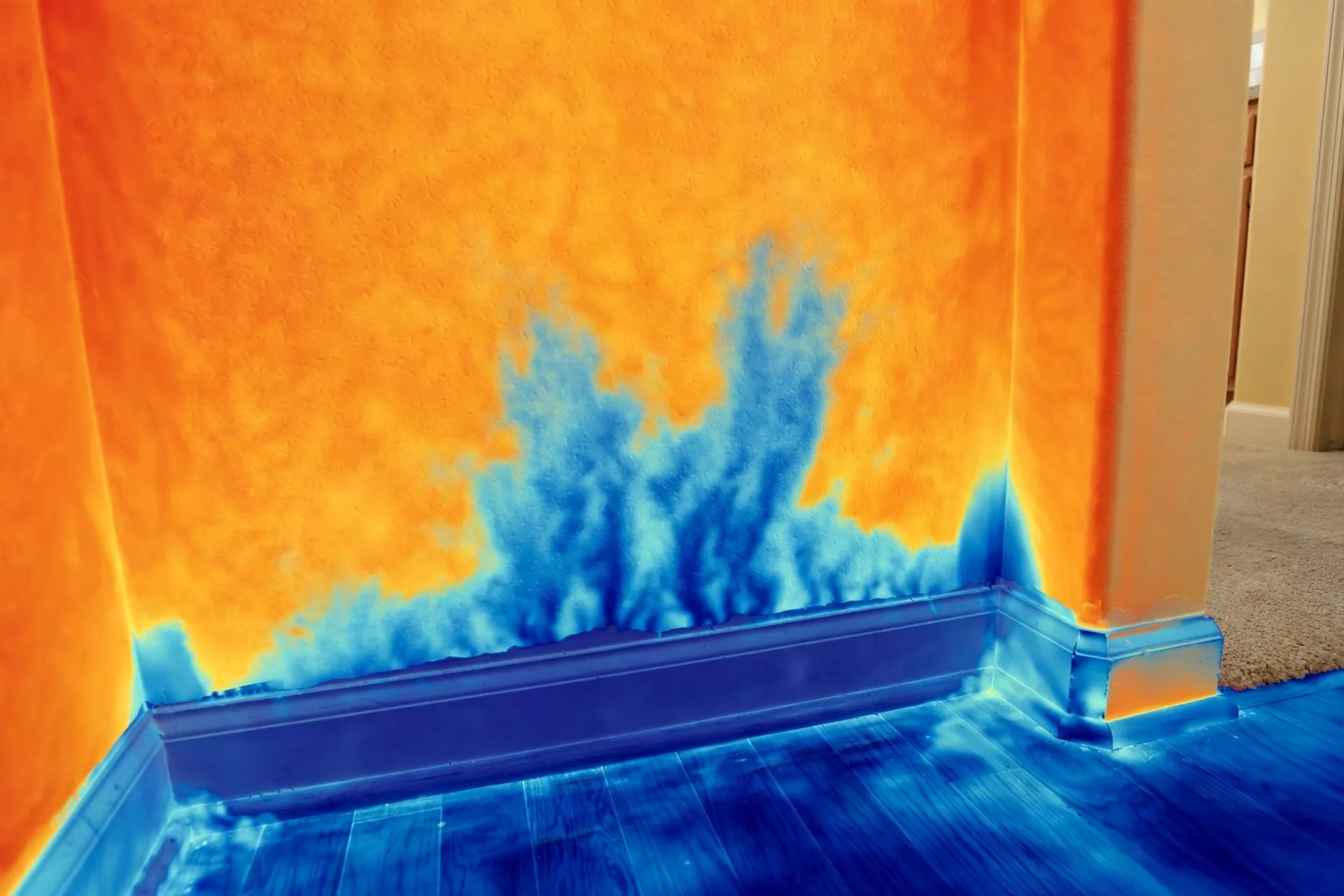
- Recurring ceiling stains that return or grow without an identified source.
- Damp or discolored wall surfaces, patches that look or feel different from the surrounding area.
- Areas that feel unusually cool or warm compared with the rest of the same surface.
- Repeated moisture in one localized area, even when it dries out between episodes.
- Suspicion of a concealed plumbing leak behind a finished surface, where opening the wall on a guess is the alternative.
- Moisture that persists without an obvious source, no visible drip, no failed fixture, no clear explanation.
Every one of these can also be caused by exterior water intrusion, condensation or another building condition rather than a plumbing leak, which is exactly why the investigation interprets patterns instead of jumping to a source. The symptom guide signs of a hidden water leak covers the wider checklist.
How a Thermal Imaging Inspection Works
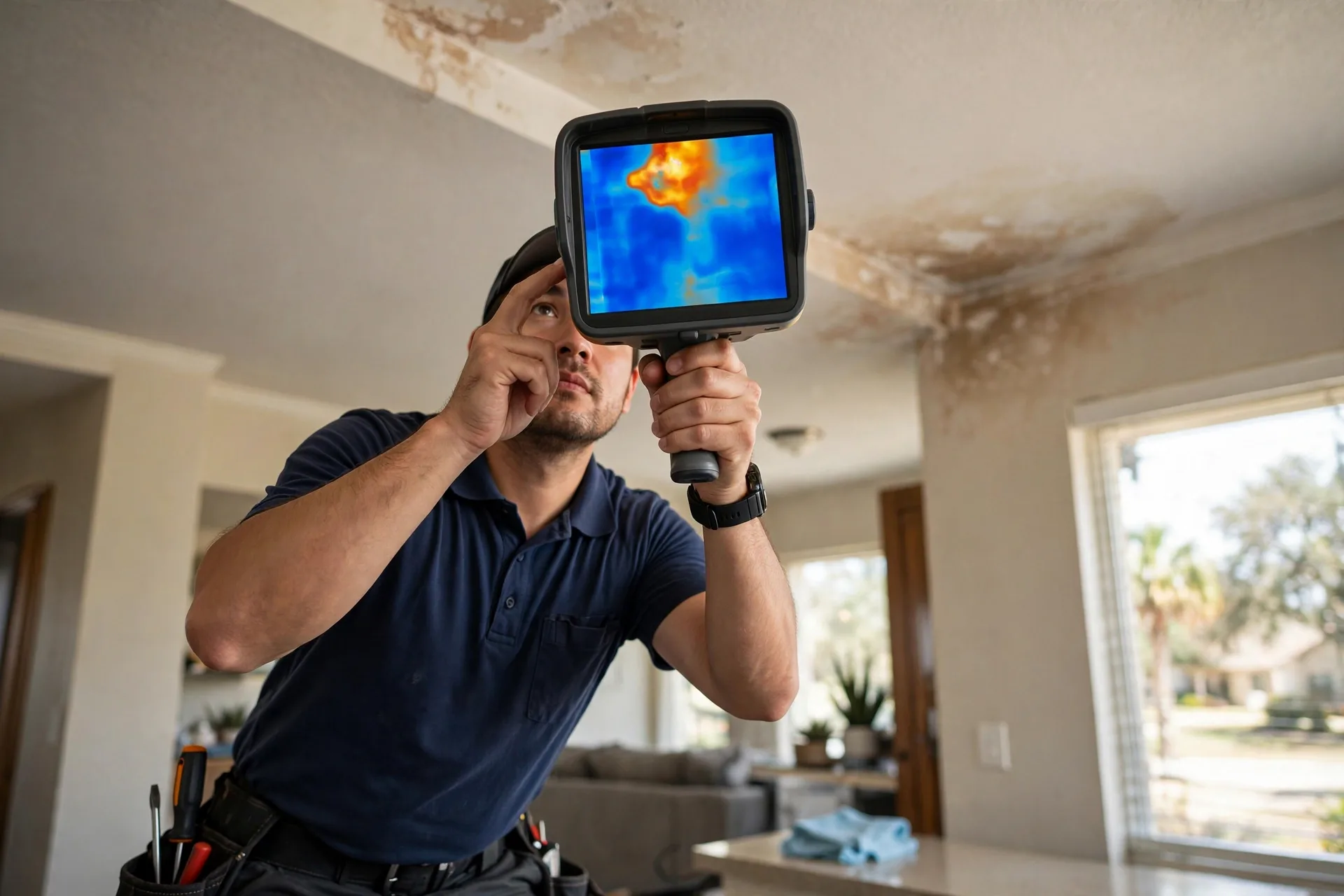
The exact procedure varies with the property, conditions and provider, but a typical inspection follows this shape:
Gather symptom information
Where the moisture or stain is, when it appears, what it seems to follow, and any history of plumbing or roof problems in that area.
Assess conditions and surfaces
The accessible surfaces, the materials involved, and the environmental conditions that affect how thermal patterns should be read.
Scan and observe
Thermal observations are collected across the affected area and compared with unaffected areas of the same surface.
Interpret, confirm, explain
Patterns are interpreted in context, checked with moisture measurement or other tests where needed, and the findings and next steps are explained.
Thermal Camera vs. Moisture Meter
These two instruments are constantly confused, and they answer different questions:
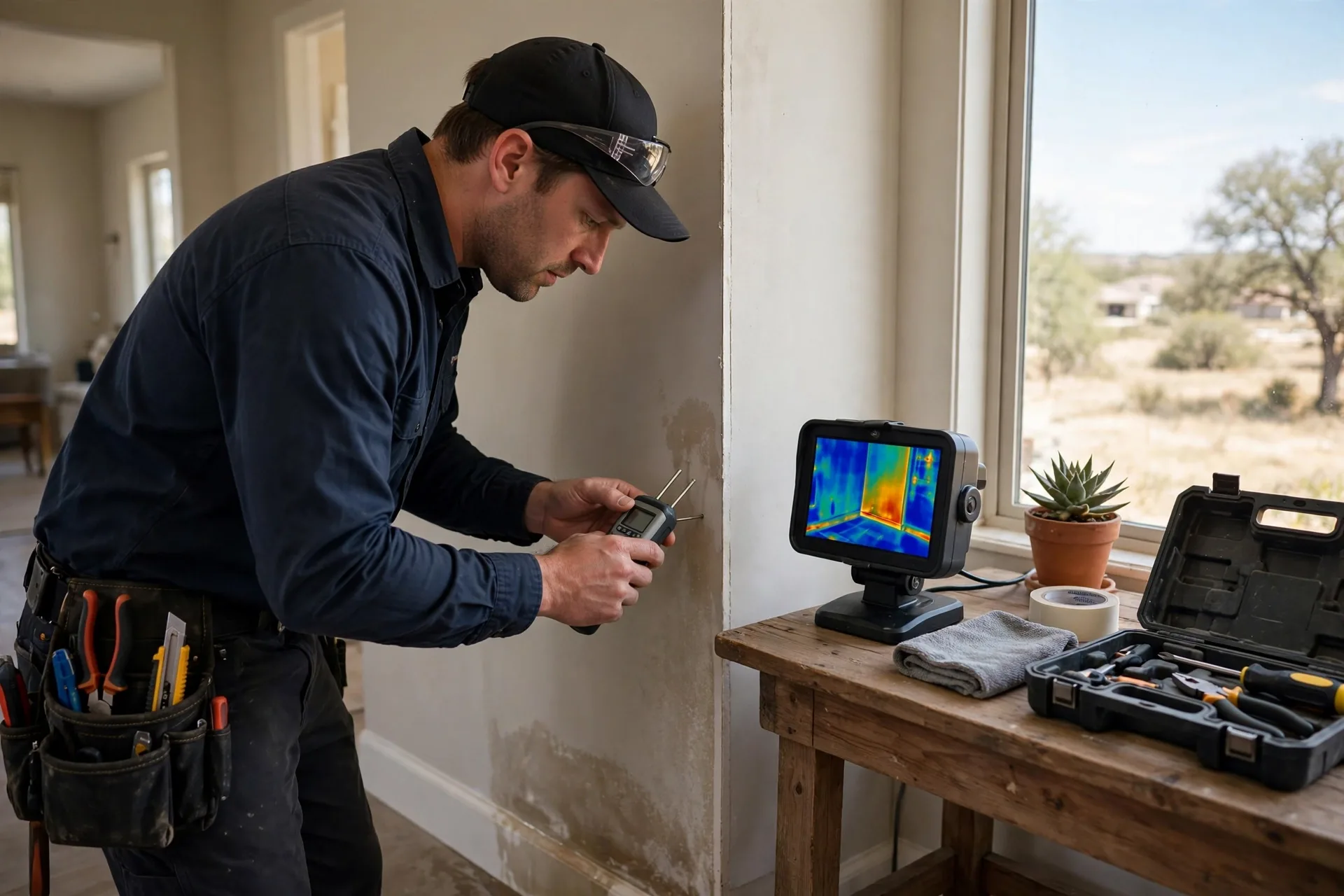
Neither instrument alone definitively diagnoses every concealed plumbing problem; each covers the other's blind spot. The detailed comparison is in moisture meter vs. thermal camera.
Thermal Imaging vs. Acoustic Detection
The other comparison that matters is with sound. Thermal imaging reads temperature patterns on surfaces, its natural territory is moisture in walls, ceilings and floors. Acoustic detection listens for the sound of water escaping a pressurized pipe, its natural territory is locating a leak in a line, including buried ones a camera cannot assess at all.
Neither is universally better. A damp wall with an unknown source calls for thermal scanning first; a pressurized line losing water with no surface symptoms calls for listening equipment. Often the two are used in sequence, each narrowing what the other cannot. The acoustic ground microphone testing page covers the sound-based method in full.
What Can Affect Thermal Observations?
Thermal images are only as good as their interpretation, and interpretation depends on conditions:
- Ambient temperature, a small temperature difference between damp and dry material is harder to read when the whole room is uniform.
- Relative humidity, high humidity slows evaporation, and evaporation is what makes many damp areas read cooler.
- Air movement, drafts and HVAC airflow cool surfaces unevenly and can imitate or hide moisture patterns.
- Insulation, missing or compressed insulation creates cold patches that look like moisture but are not.
- Building materials and surface finish, materials conduct heat differently, and glossy or reflective surfaces can reflect infrared from other sources and distort a reading (a property called emissivity).
- Thermal bridging, framing and other structural elements conduct heat differently from the wall around them, producing regular patterns that are construction, not water.
- Recent heating, cooling or water use, a recently run shower, a hot-water line in use, or sun on an exterior wall all leave temperature patterns that have nothing to do with a leak.
A competent provider names these factors when explaining findings rather than presenting a colorful image as self-explanatory. There are no universal temperature thresholds that "mean leak", context is the method.
What Affects the Cost of a Thermal Moisture Inspection?
This website does not set inspection prices, and quoting a figure without seeing the property would be misleading. A provider's price generally reflects:
- The size of the area to investigate.
- How accessible the suspected source is.
- How complex the symptoms are.
- Which methods or follow-up testing the case requires.
- The type of property and materials involved.
- Whether other diagnostic work or a repair assessment is needed.
Keep the costs separate in your mind: the inspection, any repair, and any remediation or reconstruction of damaged surfaces are three different pieces of work, priced separately. See leak detection cost factors for the general structure.
Preparing for a Thermal Imaging Inspection
- Identify the affected room or surface as precisely as you can.
- Note when the moisture or stain first appeared, and whether it recurs.
- Note what it seems to follow, fixture use, rain, heating or cooling cycles.
- Identify nearby plumbing fixtures and other potential water sources.
- Mention any recent heating, cooling or maintenance changes that could affect temperatures.
- Share any previous inspection findings for the same area.
- Ask the provider which methods will be used, what the inspection includes, and whether follow-up testing is priced separately.
Opening a wall or ceiling before the scan can change the moisture and temperature patterns the inspection needs to read, and may be unnecessary if the evidence points elsewhere. Describe what you can see, leave surfaces intact, and let the investigation decide where, if anywhere, an opening is justified. Never open areas near electrical fittings that are wet.
Choosing the Right Provider: Questions to Ask
- Is thermal imaging appropriate for this suspected issue?
- Will the inspection include moisture measurements to check thermal patterns?
- What exactly does the assessment include?
- What evidence would lead you to recommend further testing?
- Is a written explanation of the findings available?
- Are further tests and any repair work billed separately?
- What credentials or licensing apply to the proposed work?
These are general evaluation questions, not verified claims about any specific provider. See also questions to ask a leak detection provider.
Thermal Imaging in the DeSoto Area
This page focuses on thermal imaging and moisture scanning for homes and properties in DeSoto, Texas, including the 75115 and 75123 ZIP code areas. Those ZIP codes are coverage references, not a guarantee that every address can be served, when you call, give the full property address so the provider can confirm eligibility. Where the suspected problem is under the slab or in a buried line, thermal imaging plays at most a supporting role; start with slab leak detection or underground main line detection. The DeSoto service-area directory lists the wider coverage.
Thermal imaging supports the broader leak detection desoto tx process by showing where moisture evidence should be measured and compared first.
Frequently Asked Questions
What is thermal imaging leak detection?
It is the use of an infrared camera to map surface-temperature patterns across walls, ceilings or floors as part of a leak or moisture investigation. Because damp material often sits at a different temperature from the dry material around it, the patterns help a provider decide where to measure moisture, run other tests or look more closely. It is a guidance method within an investigation, not a standalone leak detector.
Can an infrared camera see water inside a wall?
No. An infrared camera measures infrared radiation coming from a surface and displays its temperature, it does not see through the wall or picture the water itself. What it can reveal is the temperature effect moisture has on the surface, such as a cooler patch where damp drywall is evaporating. That is useful evidence, but it is an effect of the moisture, not an image of it.
Can thermal imaging confirm a water leak?
No. A thermal pattern can have several explanations, moisture, but also insulation gaps, airflow, thermal bridging through framing, reflections or recent heating and cooling. Confirming a leak requires corroborating evidence, typically moisture-meter readings at the patterned spots plus plumbing tests such as pressure or isolation testing. Thermal imaging narrows the search; it does not close the case.
What is the difference between a thermal camera and a moisture meter?
A thermal camera measures surface temperature over a wide area and shows patterns; it does not measure moisture. A moisture meter measures the moisture content of a specific material at a specific point, using contact pins or a pinless scan. The camera is the better mapping tool, the meter is the better verifying tool, and inspections often use the camera first and the meter to check what the camera found.
Can thermal imaging help investigate a ceiling water stain?
Yes, it is one of the commonest uses. Scanning the stain and the ceiling around it can show the shape and extent of the temperature pattern moisture is producing, whether it matches a pipe run or fixture above, and whether damp material extends beyond the visible mark. It cannot by itself say whether the source is plumbing, the roof or condensation, that takes the pattern plus history and, usually, moisture readings and other tests.
How does thermal imaging differ from acoustic leak detection?
Thermal imaging reads surface-temperature patterns and suits moisture problems in walls, ceilings and floors. Acoustic detection listens for the sound of water escaping a pressurized pipe and suits locating leaks in lines, including buried ones thermal imaging cannot assess. They answer different questions, and a provider may use both in sequence, thermal evidence to understand the moisture, acoustic testing to locate the pipe fault.
What environmental factors affect thermal observations?
Ambient temperature, relative humidity, air movement and HVAC airflow, insulation condition, the building materials and surface finish (including reflective surfaces and emissivity), thermal bridging through framing, and recent heating, cooling, sunlight or water use. All of these can create, imitate or mask the temperature patterns moisture produces, which is why findings are always interpreted in context rather than read straight off the image.
Does a thermal imaging inspection include leak repair?
No. A thermal imaging and moisture inspection is diagnostic: it investigates the moisture concern and produces evidence about its extent and likely source. Repair of any pipe or fixture, and any remediation or reconstruction of surfaces, are separate work with their own scope and pricing, agreed with the provider after the findings. Detection never automatically includes them.
What affects the cost of a thermal moisture inspection?
The main factors are the size of the area to investigate, the accessibility of the suspected source, the complexity of the symptoms, which methods and follow-up tests are required, and the type of property and materials involved. Inspection pricing is separate from repair and restoration costs, and this website does not set prices, ask the provider what the inspection includes and what it costs before booking.
What information should I have ready before calling?
The affected room or surface, when the moisture or stain first appeared and whether it recurs, what it seems to follow (fixture use, rain, heating or cooling), nearby plumbing fixtures and other water sources, any recent heating, cooling or maintenance changes, and any previous inspection findings. Have the full property address and ZIP code ready so coverage can be confirmed.
How does the DeSoto Leak Detection referral process work?
You call (972) 947-9742 and describe the moisture concern, the affected surfaces and the property address. Your request is directed toward an independent provider for thermal imaging and moisture inspection, and that provider confirms method suitability, scope, availability, pricing and next steps directly with you. DeSoto Leak Detection does not perform the inspection or any repair itself.