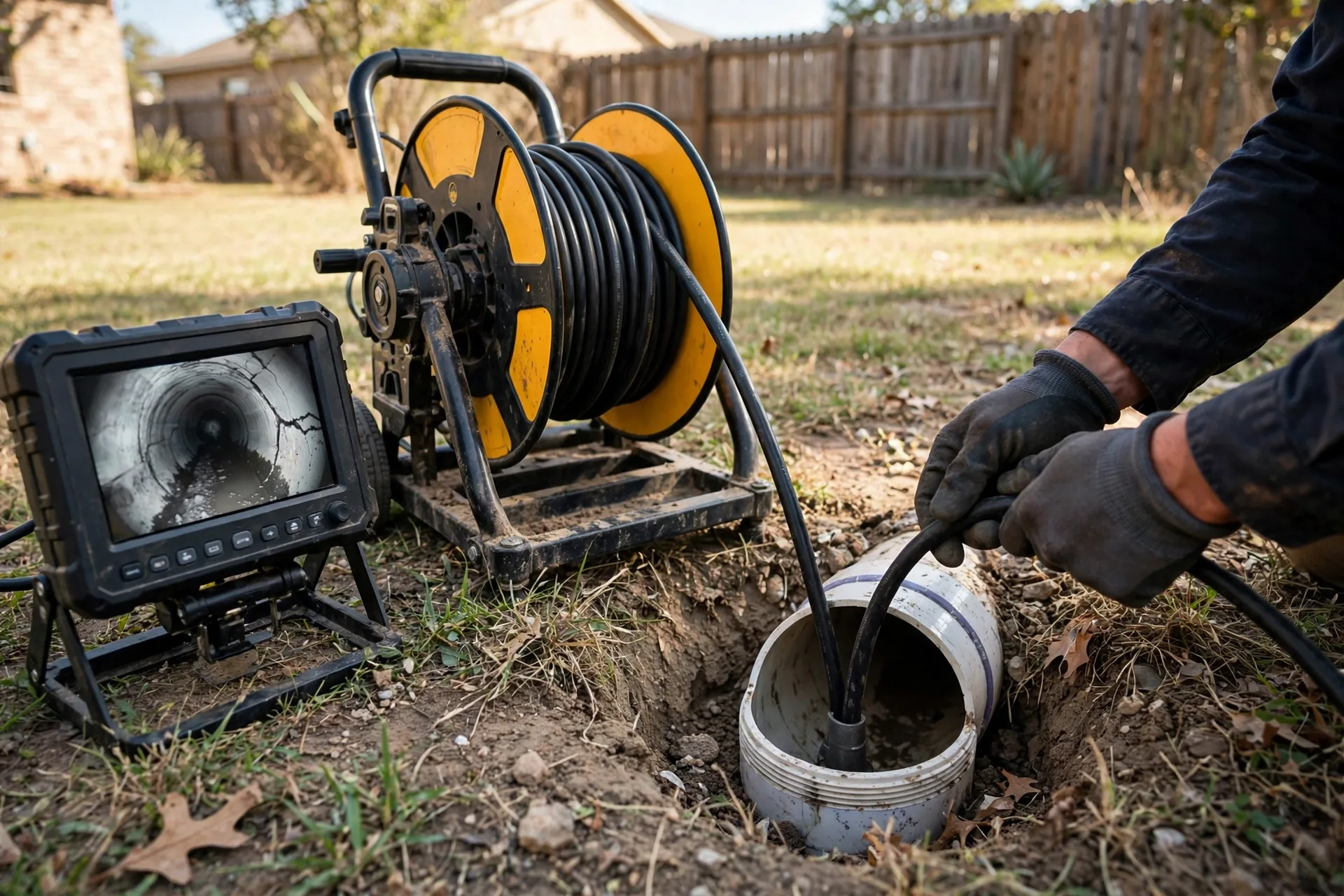
How a sewer camera inspection works
The camera head, a waterproof unit with its own lights, is attached to a flexible push rod and fed into the line, most often through a cleanout access point in the yard or at the home. As it travels, it sends a live image to a monitor at the surface, and the run can be recorded. A distance counter tracks how far the camera has gone, which helps connect what is seen underground to the layout of the home above it.
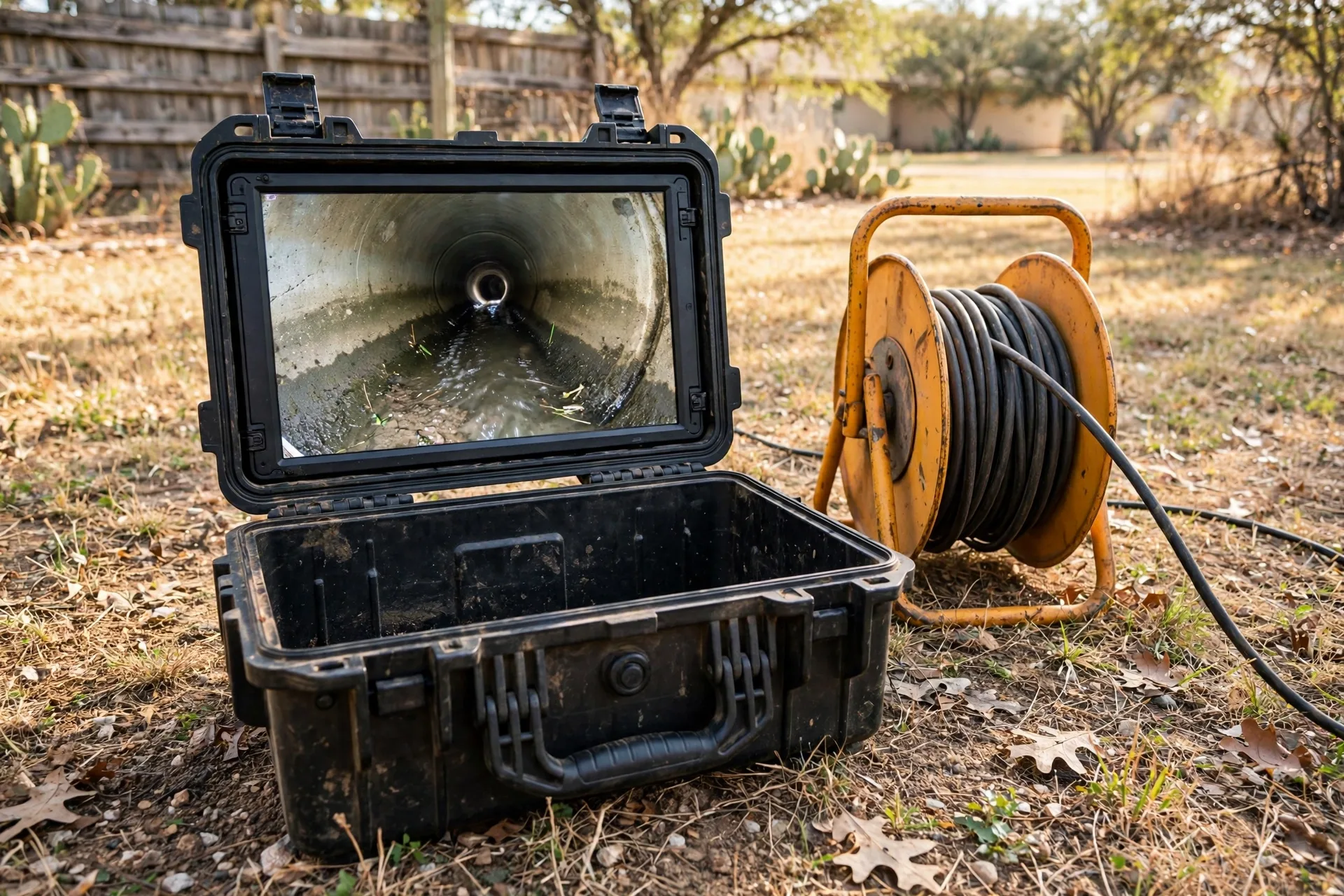
Most inspection cameras also carry a transmitter, sometimes called a sonde, in the camera head. A receiver at the surface can pick up that signal to mark where the camera is, and roughly how deep, so a defect seen on screen can be flagged on the ground above it. That locating step is what turns a picture into a repair plan. Visibility is the main limit: a line full of water, grease or debris shows the camera very little until it is cleaned, and tight bends or long runs can limit how far the camera travels.
What a camera can show
- Root intrusion: roots entering at joints, a common cause of recurring sewer blockages.
- Blockages and buildup: grease, scale and debris narrowing the line.
- Offsets and misaligned joints: sections of pipe that have shifted relative to each other.
- Cracks and breaks in the drain line wall that the camera passes.
- Bellied sections: sags in the line that hold water and collect solids.
- Foreign objects and construction debris sitting in the line.
- General material and condition of the visible inside surface along the run.
For a drain or sewer question, that list covers most of what a homeowner or buyer actually needs: whether the line is clear, damaged, invaded by roots or deformed, and where along the run the problem sits. Recorded footage also serves as documentation for a seller, a buyer or an insurer.
What a camera cannot show
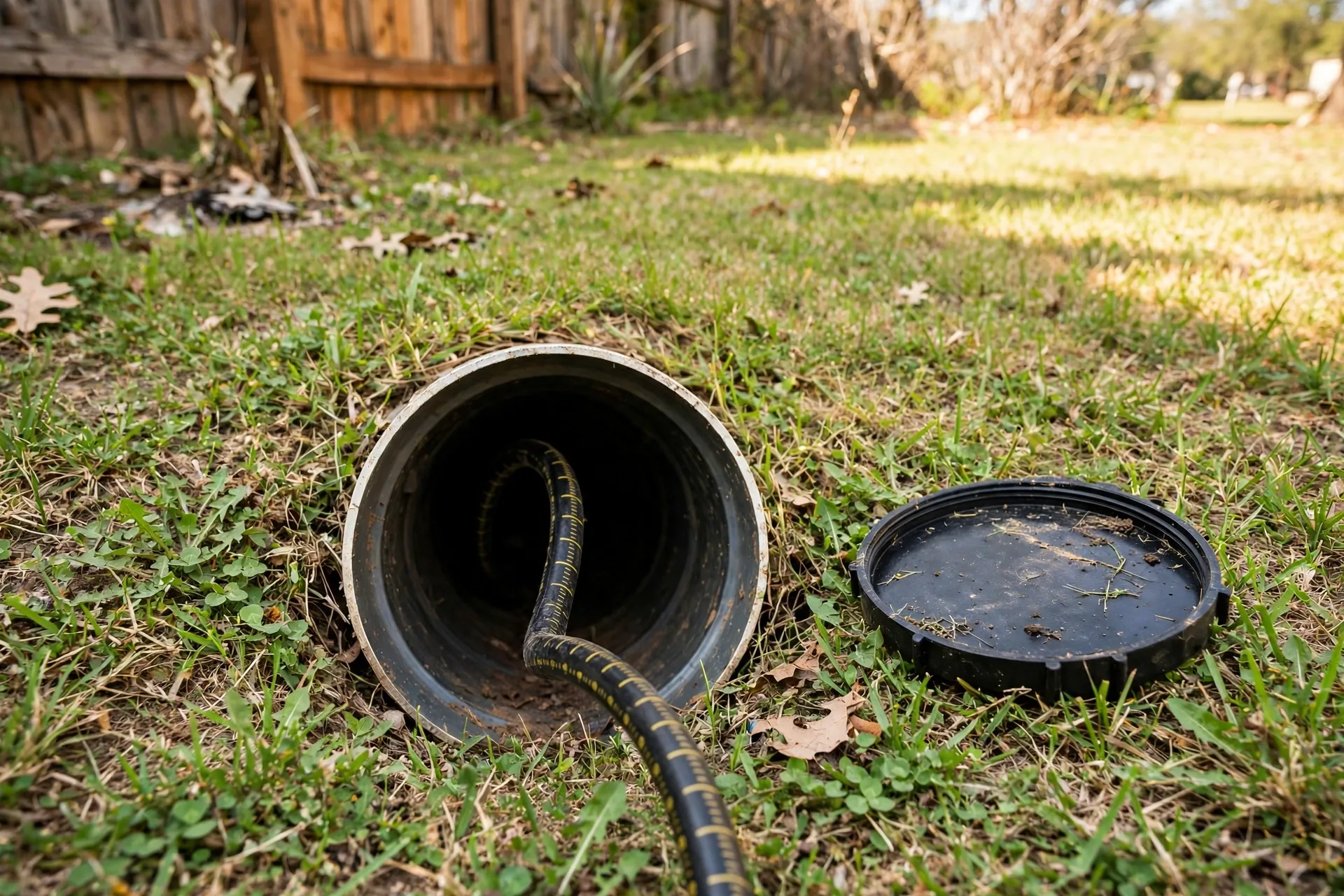
The limits follow from what the tool is. A camera travels inside drain and sewer lines, which carry water away by gravity. The pressurized supply system, the pipes that bring water in and that cause slab leaks, meter movement and pressure drops, is a separate network the camera never enters. A camera therefore cannot find a supply-side leak, no matter how carefully it is run.
Within its own system, it also has boundaries. It cannot see beyond a blockage until the line is cleared. It shows the inside surface, not the soil bedding outside the pipe or the exact condition of the pipe wall beyond what is visible. And a drain line that only loses water while flowing may look acceptable on camera while still failing a pressure-based test, which is why camera findings and test results are often read together, as our hydrostatic testing guide explains.
Camera, acoustic and pressure testing: which tool for which question
- Drain and sewer questions (backups, slow drains, roots, line condition): the camera is usually the direct tool.
- Pressurized supply leaks (meter movement, warm floor spots, pressure loss): pressure testing confirms the loss, and acoustic listening narrows the location, as our acoustic ground microphone guide describes.
- Hold-or-lose questions about a whole system, such as before a purchase: a hydrostatic or pressure test answers first, then the camera can show the drain-side defect behind a failed result.
- Mixed or unclear symptoms: the methods are combined, because each one only answers its own question.
Our comparison of sewer line versus water line leaks is a useful starting point if you are not sure which side of the system your symptoms belong to.
When a camera is the right first step, and when it is not
A camera inspection is a sensible first step when drains back up repeatedly, several fixtures drain slowly together, roots are suspected in an older line, a home purchase calls for a look at the under-slab drains, or a drain-side pressure test has failed and the defect needs to be seen. In those cases the camera usually shortens the path from symptom to a defined repair scope.
It is usually the wrong first step when the meter spins with all fixtures off but drains behave normally, when a floor has a warm spot, or when water pressure has dropped across the house. Those are supply-side patterns; starting with supply-side testing avoids paying to photograph the inside of a healthy drain while the actual leak keeps running.
What to ask, and what you should receive
- Will the inspection be recorded, and will I receive the footage or a link to it?
- Will problem locations be marked at the surface with the locator, and noted by distance?
- If the line is too dirty to see, is cleaning included or quoted separately?
- Will I get a short written summary of what was found and what it means?
- If the problem turns out to be on the supply side, what testing do you recommend next?
A camera run that produces a recording, surface marks and a written summary gives you something durable: evidence a repair quote can be built on, and documentation that stays useful if the home is sold. That is the standard to ask for, whichever provider performs the work.
Common questions
Can a sewer camera find a water line leak?
Not a pressurized one. A sewer camera inspects the inside of drain and sewer lines, while water line (supply) leaks sit in a separate, pressurized network the camera cannot enter. Supply leaks are confirmed with pressure testing and narrowed with acoustic or tracer methods. The camera can still help on the drain side, and its locator can mark where a drain line runs.
Does a camera inspection damage the pipe?
No, the camera is designed to travel through existing access, usually a cleanout, without cutting or altering the line. If the pipe is heavily blocked or scaled, the line may need cleaning before the camera can see anything useful, and that cleaning is a separate step the provider should explain and price in advance.
Can a camera explain a failed hydrostatic test?
On the drain side, often yes. A hydrostatic test can show that an under-slab drain system is losing water; a camera run can then show the likely reason, such as roots, an offset joint or a break, and the locator can mark where it is. On the supply side, the follow-up is pressure and acoustic work instead, because the camera cannot enter those lines.
How does the camera locator work?
The camera head contains a small transmitter, called a sonde, that sends out a signal as it travels. A receiver at the surface picks up that signal to estimate the camera position and depth, so the operator can place a mark on the ground or floor above the defect. That mark, plus the distance counter, connects the on-screen image to a real location.
What if my home has no cleanout?
Access is sometimes possible through another opening, such as a vent or by temporarily removing a fixture, but options depend on the plumbing layout and some inspections end up limited. A provider can tell you what access exists at your home and what can realistically be inspected before any work begins, so ask about access when you book.
Is a camera inspection worth it before buying a home?
It can be, because drain condition under a slab is one of the things a standard inspection sees least well. A camera run can reveal roots, offsets or breaks that would otherwise surface after the purchase, and it pairs naturally with hydrostatic testing of the drains. Whether it is worth it depends on the home age, symptoms and what the seller can document already.
Sources and further reading
Need help with a suspected leak?
Call and explain the symptom, property type and ZIP. This referral service can help connect you with an appropriate local professional.